Local Business Google Profile Study 2026: PH and Australia
By Tony Hildén
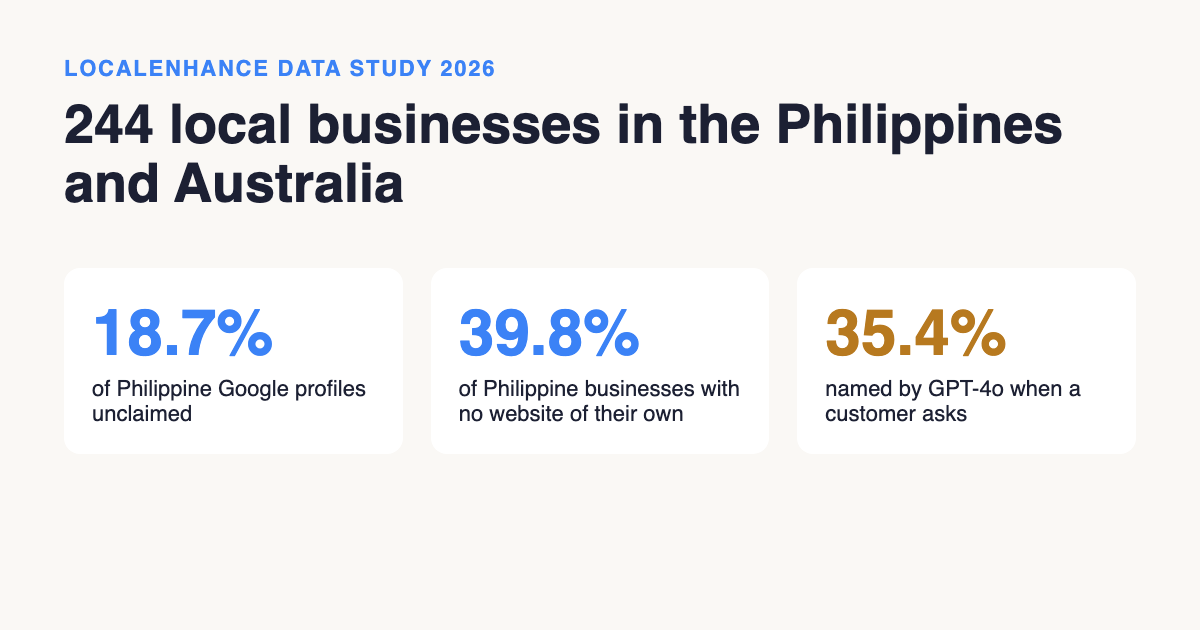
Short version: between 3 July and 13 October 2026 we ran our audit on 244 local businesses, 176 in the Philippines and 68 in Australia. In the Philippines, 26 of 139 Google Business Profiles (18.7%) had never been claimed by the owner. In Australia it was 1 of 68. Four in ten Philippine businesses had no website of their own. When we asked GPT-4o the kind of question a customer would ask, it named 29.6% of the Philippine businesses and 45.0% of the Australian ones.
Every figure below comes from our own audit records. No business is named, and the method and its limits are set out in full further down.
| Philippines | Australia | |
|---|---|---|
| Businesses in the study | 176 | 68 |
| Google listings, counting branches | 372 | 141 |
| Unclaimed profile | 26 of 139 (18.7%) | 1 of 68 (1.5%) |
| No website link on the profile | 50 of 176 (28.4%) | 0 of 68 |
| Social page in place of a website | 20 of 176 (11.4%) | 1 of 68 (1.5%) |
| Median review count | 88 | 320 |
| Under 50 reviews | 64 of 153 (41.8%) | 13 of 66 (19.7%) |
| Median rating | 4.6 | 4.5 |
| Rated 4.5 or higher | 98 of 153 (64.1%) | 35 of 66 (53.0%) |
| Named by GPT-4o at least once | 29 of 98 (29.6%) | 27 of 60 (45.0%) |
| Found by Gemini with Google Search at least once | 77 of 98 (78.6%) | 52 of 60 (86.7%) |
Nearly one in five Philippine profiles is unclaimed
A Google Business Profile exists for most businesses whether the owner made it or not. Google builds one from maps data and customer edits. Until the owner claims it, nobody can answer reviews, fix the hours, add photos that are theirs or post an update. Google shows a "Claim this business" link on those listings, and that link is what this figure counts.
Of the 139 Philippine businesses where we could read the claim status, 26 were unclaimed. The Australian sample had one in 68. The unclaimed businesses were smaller on Google: a median of 38 reviews against 163 for claimed ones. Thirteen of the 27 also had no website link, so for those the unclaimed profile was the only thing a searcher could find.
Health and professional services looked worst in the Philippines, with 4 of 10 clinics and 4 of 12 professional firms unclaimed. Those groups are small, so read them as a pointer and not a rate. Food and drink was the best kept, at 4 of 49.
Chains are not immune. We read the claim status of 77 branch listings belonging to Philippine businesses with three or more branches. Twenty were unclaimed, spread across 5 of the 20 chains. A head office can run a tidy main profile and still have branches that nobody owns.
Four in ten Philippine businesses have no website of their own
Fifty of the 176 Philippine businesses had no website link on their profile. Another 20 linked to a Facebook or Instagram page in the website field. Together that is 70 of 176, or 39.8%, with nothing of their own to send a customer to. Retail (8 of 15) and beauty and wellness (10 of 23) had the most gaps. Every one of the 13 professional firms had a site.
In the Australian sample all 68 had a website link, and one of those was a social page. The Australian group leans toward established venues in New South Wales, which is part of the reason. It is still a wide gap between the two markets.
A social page is better than nothing, but it gives Google and the AI assistants very little to read: no menu or service pages, no prices, no address markup. We cover why that matters in how AI reads your website.
Review counts differ by a factor of 70 between industries
The median Philippine business had 88 Google reviews and the median Australian one had 320. Under 50 reviews: 41.8% in the Philippines, 19.7% in Australia.
Industry matters more than country. A Philippine restaurant or café had a median of 288 reviews. A Philippine clinic had 14. People review dinner far more readily than a dental visit, so a clinic with 40 reviews can lead its area while a restaurant with 40 is close to invisible. Compare yourself with your own category.
| Philippines, by industry | Businesses | Unclaimed | No website link | Median reviews | Rated 4.5 or higher |
|---|---|---|---|---|---|
| Food and drink | 63 | 4 of 49 | 16 of 63 | 288 | 39 of 61 |
| Beauty and wellness | 23 | 2 of 17 | 10 of 23 | 40 | 16 of 22 |
| Stays and travel | 18 | 2 of 14 | 3 of 18 | 192 | 9 of 15 |
| Health | 15 | 4 of 10 | 5 of 15 | 14 | 10 of 12 |
| Retail | 15 | 4 of 12 | 8 of 15 | 29 | 6 of 11 |
| Professional services | 13 | 4 of 12 | 0 of 13 | 21 | 8 of 10 |
| All Philippine businesses | 176 | 26 of 139 | 50 of 176 | 88 | 98 of 153 |
Ratings are high everywhere, so they separate nobody
The median rating was 4.6 in the Philippines and 4.5 in Australia. In the Philippines 64.1% of businesses sat at 4.5 or higher. When two thirds of the field has the same score, the score stops being a reason to choose one.
The one group that broke the pattern was Australian food and drink: a median of 1,010 reviews and a median rating of 4.3, with only 11 of 33 at 4.5 or above. More reviews pull a rating toward the honest middle. A 4.3 from a thousand people is a stronger signal than a 4.9 from twenty, and Google treats it that way. See how Google reviews affect ranking.
GPT-4o names about a third of local businesses
For 158 of the businesses we also ran an AI visibility check. Each got 10 or 15 questions a customer might type, such as a service plus a neighbourhood, with the business name left out. We put each question to GPT-4o, the model behind ChatGPT, through its API with no web browsing. We put the same questions to Gemini with Google Search switched on.
GPT-4o named 29 of 98 Philippine businesses (29.6%) and 27 of 60 Australian ones (45.0%) at least once. Counted per question, it named the business in 137 of 1,017 Philippine answers (13.5%) and 160 of 680 Australian answers (23.5%).
Gemini with live search did much better: 78.6% of Philippine businesses and 86.7% of Australian ones turned up at least once. That leaves 52 Philippine businesses and 27 Australian ones that live search could find and the model's own memory could not. Seventeen Philippine businesses and six Australian ones were found by neither.
What separates the named from the unnamed is mostly how much the internet has written about them. Businesses GPT-4o named had a median of 978 Google reviews. The ones it did not name had 120. Below 200 reviews the rate was about one in five. At 1,000 or more it was three in four.
Review count is standing in for something broader here: a business with a thousand reviews also tends to have press mentions, directory listings and a real website. A model trained on the public web has met it many times. A business with 30 reviews and a Facebook page has left almost no trace to learn from.
What to do with this
- Check whether your profile is claimed. Search your business name on Google Maps. If you see "Claim this business" or "Own this business?", it is not yours yet. Claiming is free and takes a few days.
- Get a website of your own, even a small one. One page with your services, prices, address and hours gives Google and the AI assistants something to read that a social page does not.
- Measure reviews against your category. Use the table above. If you are a clinic with 60 reviews you are well ahead. If you are a restaurant with 60 you have work to do.
- Stop chasing a perfect rating. Almost everyone has 4.5. Volume and recent reviews are what move you.
- Get written about. Being named by an AI assistant follows from being mentioned across the web: listings, local press, supplier and partner pages.
You can see where your own business stands on each of these with our free audit. It runs the same checks this study is built from.
Method
Source. Records of audits run on the LocalEnhance platform between 3 July and 13 October 2026. Each audit reads the business's Google Business Profile, and most also run the AI visibility check.
Who is in it. 1,115 audits reduced to 554 distinct Google listings by Google's place ID, then to 513 in the Philippines (372) and Australia (141) by address. Listings were grouped into 244 businesses, so a chain with 40 branches counts once, by its main listing. Where a listing was audited more than once we used the first reading, which is the state we found it in before any work. Two records that were our own test entries were removed.
Claim status is the field Google exposes as the "Claim this business" link. It was available for 207 of the 244 businesses, because earlier audits did not record it. In a separate check, 7 of 7 listings opened on Google Maps matched the stored value, and no listing changed status between repeat audits.
Website is the website field on the profile. A business with a site that is not linked from its profile counts as having none here.
Industry comes from the profile's primary Google category, grouped by us into seven groups. Groups with fewer than 10 businesses are not shown on their own.
AI visibility. 158 businesses had a completed check. Questions were written by a model from the business's category and location and did not contain its name. A second model judged whether each answer named the business. We checked that judgement against a plain text search for the business name: it agreed on 80% of answers marked as naming the business and 98% of those marked as not. Answers that failed to analyse (8 of about 9,400) count as not named.
Limits. This is not a random sample. About 70% of the businesses were chosen by our team as prospects or are clients, and 30% requested an audit themselves. The Australian group is small, and about half of it is food and drink venues in New South Wales. Treat the country comparison as a description of these 244 businesses and not as a national rate. The AI figures describe one model on the dates tested and will move as models change.
Journalists and researchers are welcome to quote these figures with a link to this page. For the underlying tables, get in touch.
Frequently Asked Questions
How many Google Business Profiles are unclaimed?
In our 2026 study, 26 of 139 Philippine businesses (18.7%) had an unclaimed Google Business Profile. In the Australian sample it was 1 of 68 (1.5%).
How many reviews does a typical local business have on Google?
The median was 88 in the Philippines and 320 in Australia. It varies far more by industry: a median of 288 for Philippine restaurants and cafés against 14 for Philippine clinics.
What share of local businesses have no website?
Among 176 Philippine businesses, 50 had no website link on their Google profile and another 20 linked only to a social page, 39.8% in total. All 68 Australian businesses had a website link.
Does ChatGPT recommend small local businesses?
Sometimes. GPT-4o, asked 10 to 15 unbranded local questions per business with no web browsing, named 29.6% of Philippine businesses and 45.0% of Australian ones at least once. Businesses with 1,000 or more Google reviews were named 75% of the time, those under 200 about 20%.
What is a good Google rating for a local business?
The median was 4.6 in the Philippines and 4.5 in Australia, and 64% of Philippine businesses were at 4.5 or higher. A rating near 4.5 is ordinary, so review volume and recency matter more.
How was this study done?
We analysed 1,115 audits run on the LocalEnhance platform from 3 July to 13 October 2026, reduced to 513 Google listings and 244 businesses in the Philippines and Australia. It is not a random sample. The full method is on the page.
See where your business ranks today
The free audit checks your Google Business Profile, your Maps rank, your website and what ChatGPT says about you. Under a minute to fill in, and the scored report is emailed in about ten minutes.